- The Elizabethan Book Club

- Jun 29, 2020
- 4 min read
Updated: Aug 30, 2020
I have just had a strange thought about life. I read a sentence today, in a book by William Boyd, Any Human Heart (2002), about our lives being dragged out when we are old and, in a way gives rise to feelings of urgency to die, out of exhaustion. But as cliched as it sounds, it really had a profound affect on me, I'm sat here, in the midst of a worldwide pandemic, four months in, where we are slowly being allowed to go out, but mostly we are in solitude, either working remotely, or not at all. I suddenly feel a real pang of gratitude for the early life I have, and what I've experienced at 25.
I'm listening to Phoebe Bridges. Her words are sound astonishingly mature as though she has experienced a lifetime of love and loss, yet, she's twenty-five. Bridges says at one point, "I still hate you for what you did/ but I miss you like a little kid" she writes as storyteller, almost in prose, each song like a moment in her life. I felt this urge to remember important moments, and write them down, most recently having read Levels of Life (2013) & The Only Story (2019) by Julian Barnes.
Blake Morrison reviewed Levels of Life by Julian Barnes for the Guardian in April of 2013, interestingly, he said that Joan Didion wrote her book on grief, in little under a year after her husband died, then subsequently another when her daughter passed, whereas Julian Barnes took around 4 years, publishing Levels in 2013, literary agent Pat Kavanagh [Barnes wife] having passed away in 2008. I admire the strength it must take to let the world into your inner-most thoughts that a memoir provides, but, in another way I wonder: is this another part of the grieving process? To be understood and heard, to relate and maybe been drawn back into everyday life, outside your grief.
The loss and feelings don't go away, as everyone tells me you learn to live with it. I can't help but feel Barnes novel The Only Story, could only have been written and structured as it is, because of Levels of Life. Levels, the part biography/ part memoir has a confusing structure at first. I didn't understand it, in one way, to me it was like Barnes started the biography, then a sort of historical fiction, then his own essay on grief sort of collides with the rest of the book. I didn't know what to make of it initially. I was confused, and I think it's the genius of Barnes to draw your own conclusions on what the Levels of life really are.

Barnes tells the short history of 19th century Ballooning, and aerial photography at the forefront. So, on the surface, it's this story of a search for new beginnings and innovation, but then of looking back at yourself, in the images taken in the clouds. In these three sections of the book, I think Barnes is exploring the ideas of fact vs fantasy. I personally thought about all of the things we fantasise about in life, the 'what-ifs', like the two characters (real people Colonel Fred Burnaby & french actress Sarah Bernhardt) and their romance in the second part. We know they are real but the rest is romantic invention. I think Barnes is exploring how we look back on love, how we can have a facsimile of an event, then an imagined moment, entirely built on our own interpretation of love, and then the aftermath of love, the reality, the authors own feelings.

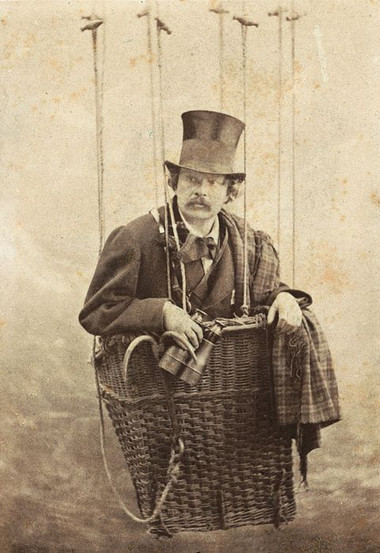


Gaspard-Félix Tournachon [Nadar] a pioneer of aerial photography in the 19th century.
I think reading this after Barnes book The Only Story, a novel written retrospectively by a middle aged man, looking back on his life, focussing on one particular part his early life, which shapes the rest of it. Written in three key sections, Barnes excellently carries us through key moments of Paul's life, we dip in and out, opening in first person, then changing tenses as he moves further away from happiness, and in a way himself. It was easier having read both books to see where the central themes of grief and devotion come from with Barnes.
This book is beautifully written, I read it in a day, it was heartbreaking. The message was such an interesting one to me, the idea we all have one key "story" in our life which defines our romantic experience, and changes us forever. It's also not necessarily the primary relationship of your life, nor is it about the longevity of the relationship. This really moved me, and weirdly I do think both books go hand-in hand, though deeply thoughtful and intense, read them both close together.
To me, it's Barnes working through things, trying to aline his thoughts - is this what love is like perhaps when you lose it, muddled and displaced? Some articles say half of the pleasure of Levels of Life, is what it doesn't say, I think it's the genius of Julian Barnes in drawing out those emotions which we often can't express to ourselves.